What a reentry permit is, and when it is needed
What a reentry permit is. A reentry permit is a travel document issued by U.S. Citizenship and Immigration Services to a lawful permanent resident or conditional permanent resident who intends to depart the United States temporarily. It allows the holder to apply for admission on return, during the period of the permit's validity, without first obtaining a returning resident visa from a consular post abroad (which would otherwise be required for absences of one year or more). INA 223, 8 U.S.C. 1203. The document itself is issued as Form I-327, Permit to Reenter the United States.
When a permit is needed. An unexpired Permanent Resident Card (a "green card"), Form I-551, is sufficient for readmission after a temporary absence of less than one year. A reentry permit becomes the operative travel document once your intended absence will last a year or longer, and it must therefore be obtained before departure. However, a reentry permit is also useful for intended absences of more than 180 days even if less than one year, because once a lawful permanent resident is absent from the U.S. for more than 180 days, any return is considered "applying for admission" to the U.S., which means that the entry will be subject to greater scrutiny (a reentry permit is useful to deal with that additional scrutiny). A permit does not replace the Permanent Resident Card or a passport; it supplements them.
What a permit proves, and what it does not
Evidence, not entitlement. The key legal benefit that a reentry permit provides, per the regulations, is that a permanent resident or conditional permanent resident holding a valid permit "who is otherwise admissible shall not be deemed to have abandoned status based solely on the duration of an absence or absences while the permit is valid." A permit therefore rebuts an inference of abandonment drawn from the length of an absence alone. It does not answer evidence of abandonment drawn from conduct or circumstances, and it confers no entitlement to be admitted.
Document validity is not status. Two questions are frequently conflated. The validity period of the permit governs the document. Permanent residence itself continues until it is abandoned or is terminated in removal proceedings, so an expired permit does not by itself end the underlying status, and a valid permit does not by itself preserve every benefit that depends on residence.
How long a permit lasts
Validity period. A permit issued to a permanent resident is valid for two years from the date of issuance. A permit issued to a conditional permanent resident is valid for two years from issuance, or until the date the conditional permanent resident must apply for removal of the conditions on residence, whichever comes first. 8 CFR 223.3(a)(1). However, there is an exception to the two year validity rule for extended absences, as discussed below.
Extended absences shorten the permit. Where the applicant has been outside the United States for more than four years in the aggregate since becoming a permanent resident, or during the last five years, whichever period is shorter, the permit is limited to a validity of one year, with certain exceptions.
No extension and no renewal. A permit is valid for not more than two years from the date of issuance and is not renewable. INA 223(b). It may not be extended. A further permit requires a new application, which must again be filed within the United States.
Where and when the application is filed
Where the application must be filed. An application for a reentry permit must be filed while the applicant is physically present in the United States and in status as a lawful permanent resident or conditional permanent resident. Departure from the United States before a decision is made does not affect the application.
Discretion, ineligibility, invalidation and appeal. USCIS may approve or deny an application as an exercise of discretion. An application will be denied where a previously issued reentry permit or refugee travel document is still valid, unless it has been returned to USCIS or is shown to have been lost.
Two things a permit does not do
The 180-day rule at the port of entry. A returning permanent resident is not regarded as seeking admission to the United States unless one of the six conditions in INA 101(a)(13)(C) (8 U.S.C. 1101(a)(13)(C)) applies, one of which is absence for a continuous period in excess of 180 days. A valid reentry permit does not remove an absence from that calculation. A permanent resident returning after an absence longer than 180 days is therefore treated as an applicant for admission, and the grounds of inadmissibility in INA 212(a) (8 U.S.C. 1182(a)) apply whether or not a permit is held. This is why no permit can guarantee admission.
Naturalization is a separate question. A reentry permit does not preserve continuous residence for naturalization. An absence of one continuous year or more breaks the continuity of residence required for naturalization. INA 316(b), 8 U.S.C. 1427(b). An absence of more than six months but less than one year breaks continuity unless the applicant establishes otherwise.
Specimen documents
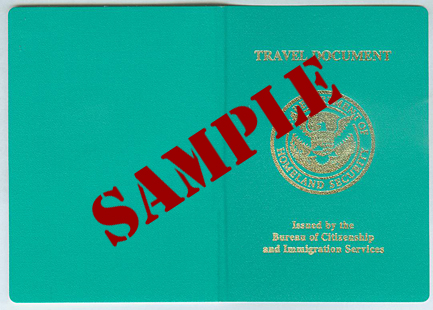
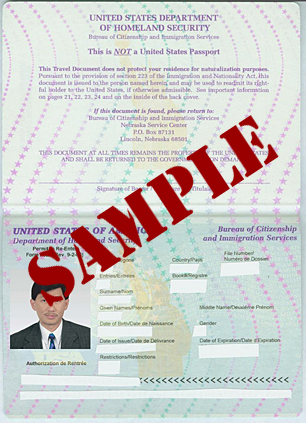
The images below show the cover and the interior of a reentry permit issued under an earlier document design. Current documents differ in appearance.
| Specimen reentry permit (Form I-327): cover |
 |
| Specimen reentry permit (Form I-327): interior |
 |
How Antao & Chuang can help
Experience with reentry permits. Antao & Chuang has many years of experience representing lawful permanent residents and conditional permanent residents in reentry permit matters, from a first application filed before a planned departure to a further application after a long period abroad.
Managing the logistics. The mechanics of these applications are unforgiving of timing errors, because the application must be filed while the applicant is still in the United States. The firm coordinates the preparation and filing of the application, the assembly of supporting evidence, attendance at the biometrics appointment, and the arrangements for delivery of the approved permit, so that a departure date and a pending application do not come into conflict.
Addressing the complications that often arise. Some examples of recurring difficulties include absences long enough to reduce a permit to one year of validity; conditional residents whose permit validity is capped by the date the conditions on residence must be removed; the bar on extension and renewal, which makes a fresh application the only route to further travel, INA 223(b); a prior permit that is still valid and must be accounted for; the waiver required of permanent residents entitled to nonimmigrant status under INA 101(a)(15)(A), (E) or (G), 8 CFR 223.2(c)(3); the effect of time abroad on continuous residence for naturalization and whether an application to preserve continuous residence for naturalization is warranted, INA 316(b); and the options remaining where a permit has expired or was never obtained.
Next steps. If you are planning on applying for a reentry permit, the first step is to contact our firm through our contact page.
Speak with us about your case
If you are a permanent resident planning an extended absence, we would be glad to hear from you before you go, while an application can still be filed from inside the United States. We are equally glad to hear from residents whose circumstances are further along: a particular itinerary that has to be worked around, a lengthy absence already underway, or a permit that has already expired. A short account of your status, the time you have spent abroad and the dates you are working to is usually enough to start; where we conclude that representation by this firm is appropriate for the matter, we will explain how we would propose to proceed. To begin that conversation, Contact us.
Frequently asked questions
What does a reentry permit actually do?
It does two things. During the permit's validity it serves as the travel document a returning permanent resident presents, so that admission can be applied for without first obtaining a returning resident visa from a consular post abroad (which would otherwise be required for absences of one year or more, since one's green card can only be used for re-entering the U.S. for absences of less than one year). It also stands as evidence that the absence was intended to be temporary: a holder who is otherwise admissible is not deemed to have abandoned status based solely on the duration of an absence while the permit is valid, 8 CFR 223.3(d)(1). A single permit may be used for more than one application for reentry during that period, INA 223(c).
More detail: What is the purpose of a reentry permit?
How long does a reentry permit last?
Generally two years from the date of issuance; a permit issued to a conditional permanent resident runs for two years or until the date the conditional resident must apply to have the conditions on residence removed, whichever comes first, 8 CFR 223.3(a)(1). There is an express exception for long absences. A permit issued to a person who has been outside the United States for more than four years in the aggregate — measured since becoming a permanent resident, or over the last five years, whichever period is shorter — is limited to a validity of one year, 8 CFR 223.2(c)(2). That one-year limit does not apply to a narrow group who may still receive two years, including certain residents employed by a public international organization of which the United States is a member and their permanent resident spouses and children, and professional athletes who regularly compete in the United States and worldwide.
Do I have to apply from inside the United States?
Yes. The application must be filed while you are in the United States and in status as a lawful permanent resident or conditional permanent resident, 8 CFR 223.2(b)(1); there is no consular route. The requirement fixes on the moment of filing rather than on the whole adjudication, and departure before a decision is made does not by itself affect a properly filed application, 8 CFR 223.2(d). The practical constraint is biometrics: USCIS may require an applicant to appear, the appointment is at a facility in the United States, and departing before it is taken is the most common obstacle to an otherwise valid application. The departure date and the appointment therefore need to be planned together.
More detail: Can a reentry permit be obtained from outside the U.S.?
Can a reentry permit be renewed or extended?
No. The statute provides that a permit is not renewable, INA 223(b), and the regulation provides that it may not be extended, 8 CFR 223.3(c). Continued coverage means a fresh application, and that application must again be filed from inside the United States, so a resident already abroad cannot obtain another permit without returning first. Time already spent outside the United States also bears on what the next permit is worth, because the four-year rule described above can limit it to one year.
Does a reentry permit guarantee readmission?
No. No travel document guarantees admission. A permit addresses the travel-document requirement and forecloses a finding of abandonment based solely on the length of an absence; everyone applying for admission is still inspected, and the statute confines the permit's effect to showing that the holder is returning from a temporary visit abroad, INA 223(e). Abandonment can still be found on other evidence — where employment, a home, family and financial ties are, for example — and the grounds of inadmissibility are still tested wherever a returning resident is treated as an applicant for admission.
More detail: Does a reentry permit guarantee readmission?
Does it overcome a ground of inadmissibility?
No. The regulation extends its protection only to a resident "who is otherwise admissible", 8 CFR 223.3(d)(1), and the statute states that a permit has no effect under the immigration laws except to show a return from a temporary visit abroad, INA 223(e). A permit answers a question about abandonment of residence; it says nothing about admissibility. It does not switch off the 180-day trigger either, and it has no bearing on the criminal, illegal-activity, pending-process or improper-entry conditions that make a returning resident an applicant for admission.
More detail: Does a reentry permit overcome a ground of inadmissibility?
Does it preserve my continuous residence for naturalization?
No, and this is the misconception that matters most. A reentry permit protects permanent resident status against a finding that the status was abandoned because of the length of an absence. It does nothing about the continuous residence that naturalization requires: an absence of one year or more breaks the continuity of residence, and an absence of more than six months but less than one year breaks it unless the applicant establishes otherwise, INA 316(b). Keeping the status and keeping the naturalization clock running are separate problems with separate solutions.
More detail: Does a reentry permit prevent the breaking of continuity of residence for naturalization?
What if I never got a permit, or it expired or was lost abroad?
A permanent resident who is abroad without a valid card or permit, and who cannot return within the time either would have covered, may apply at a consular post for a returning resident, or SB-1, immigrant visa as a special immigrant under INA 101(a)(27)(A). The consular officer must be satisfied that permanent resident status existed at departure, that the intention to return was never abandoned, and that any protracted stay abroad was caused by reasons beyond the applicant's control. Where a card or permit was lost, stolen or destroyed abroad rather than allowed to expire, carrier documentation is the narrower route, and it is bounded by how long the absence has already run. Which route fits depends closely on the facts, and the Department of State advises approaching the post well ahead of intended travel.
More detail: What if you did not obtain a reentry permit, or it has expired, or been lost?
Related pages
This page is general information about U.S. immigration law, not legal advice, and it does not create an attorney-client relationship. Immigration rules, numerical limits and procedures change often. The law described here was reviewed in August 2026; please confirm the current position, or contact us, before acting on anything on this page.